Clean Welds That Hold Under Pressure
Professional TIG and MIG aluminum welding services for custom fabrication, repairs, and modifications.
When you need aluminum welded correctly, it's essential to work with someone who has a deep understanding of how the metal reacts to heat, including how quickly it dissipates and the technical skill required to adjust arc length and wire speed in real-time. This level of expertise is crucial to avoid complications such as burn-through or porosity, which can jeopardize the integrity of the weld. At JT-Fabrication & Welding, we handle aluminum on a daily basis, skillfully managing projects that range from thin-wall tubing used in custom motorcycle frames to the thicker structural components commonly found in commercial equipment.
To ensure the best results for your specific application, we utilize both TIG and MIG welding processes based on the unique requirements of your project. TIG welding is ideal for tasks that demand precision and control, especially when working with detailed designs, thin materials, and visible seams where aesthetics are a key consideration. On the other hand, MIG welding allows for quicker coverage on thicker sections and larger assemblies, where structural strength and durability are of utmost importance. Whether you need a cracked aluminum part expertly repaired, a custom bracket fabricated to fit your specifications, or modifications made to existing metalwork to enhance its functionality, we carefully match the welding process to the job. Our commitment is to deliver welds that are not only clean and consistent but also built to withstand significant loads over time.
If you have an aluminum project that requires experienced welding or custom fabrication, we invite you to reach out and discuss your specific needs with us. We are here to listen and find out how we can best assist you in bringing your project to life, ensuring that you receive the highest quality workmanship tailored to your specifications.
What Happens During an Aluminum Welding Job
We start by cleaning the aluminum surface thoroughly, removing any oxidation, oils, or coatings that would compromise the weld. Aluminum oxidizes quickly, and even a thin layer can prevent proper fusion, so we use stainless wire brushes and solvents dedicated to aluminum prep. Depending on the thickness and application, we select either TIG or MIG, adjust shielding gas flow, and dial in amperage and travel speed to match the material.
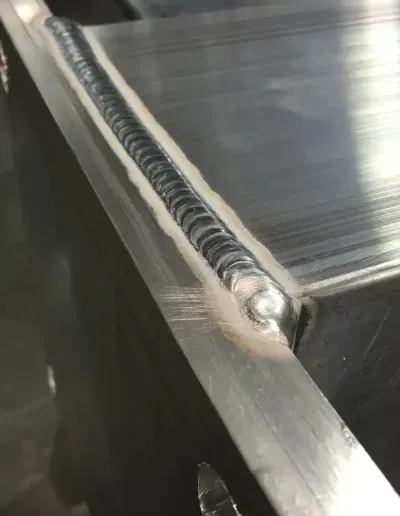
After welding, you will see smooth, uniform beads with no spatter, minimal discoloration, and full penetration where it is needed. The joint will hold under stress without cracking, warping, or separating, and if the weld is in a visible location, it will look as clean as it performs. We work on small custom jobs like brackets, enclosures, and handrails, as well as larger fabrication projects including frames, panels, and structural assemblies for commercial and industrial use.
Every project is different, and we adjust our approach based on material thickness, joint design, and how the part will be used. We do not work with cast aluminum that has high silicon content, as it requires different filler and technique, but we handle most wrought aluminum alloys used in fabrication and repair work. If you are unsure whether your part is weldable, bring it in or send a photo and we will let you know what is possible.
Questions You Might Have Before We Start
Aluminum welding is not as forgiving as steel, and most people want to know what to expect before committing to a repair or custom build. Here are answers to the questions we hear most often.
What is the difference between TIG and MIG for aluminum?
TIG uses a non-consumable tungsten electrode and filler rod, giving you precise control and clean welds on thin material or detailed work. MIG feeds wire continuously through the gun, which makes it faster for thicker sections and larger projects where speed matters more than fine appearance.
How do you prevent warping or burn-through on thin aluminum?
We control heat input by adjusting amperage, using pulse settings when needed, and tacking the joint in sequence to distribute heat evenly. Thin aluminum conducts heat quickly, so we move fast and let the material cool between passes to avoid distortion.
What types of aluminum projects do you take on?
We handle custom fabrication like brackets, enclosures, frames, and panels, as well as repairs to cracked or broken aluminum parts. Projects range from small one-off pieces to larger commercial and industrial assemblies that require multiple welds and tight tolerances.
Why does aluminum require different preparation than steel?
Aluminum forms an oxide layer almost immediately after exposure to air, and that layer melts at a much higher temperature than the base metal. If you do not remove it before welding, the oxide prevents fusion and leaves weak, contaminated joints.
How long does a typical aluminum welding job take?
It depends on the size and complexity of the part, but small repairs or single welds can often be completed in under an hour. Larger fabrication projects that involve multiple joints, fixtures, and finishing work may take several hours or longer depending on design and material thickness.
JT-Fabrication & Welding works with aluminum every day, and we know how to adjust technique, filler, and shielding gas to match the job in front of us. If you need a part welded, repaired, or built from scratch, contact us to talk through your project and get it scheduled.